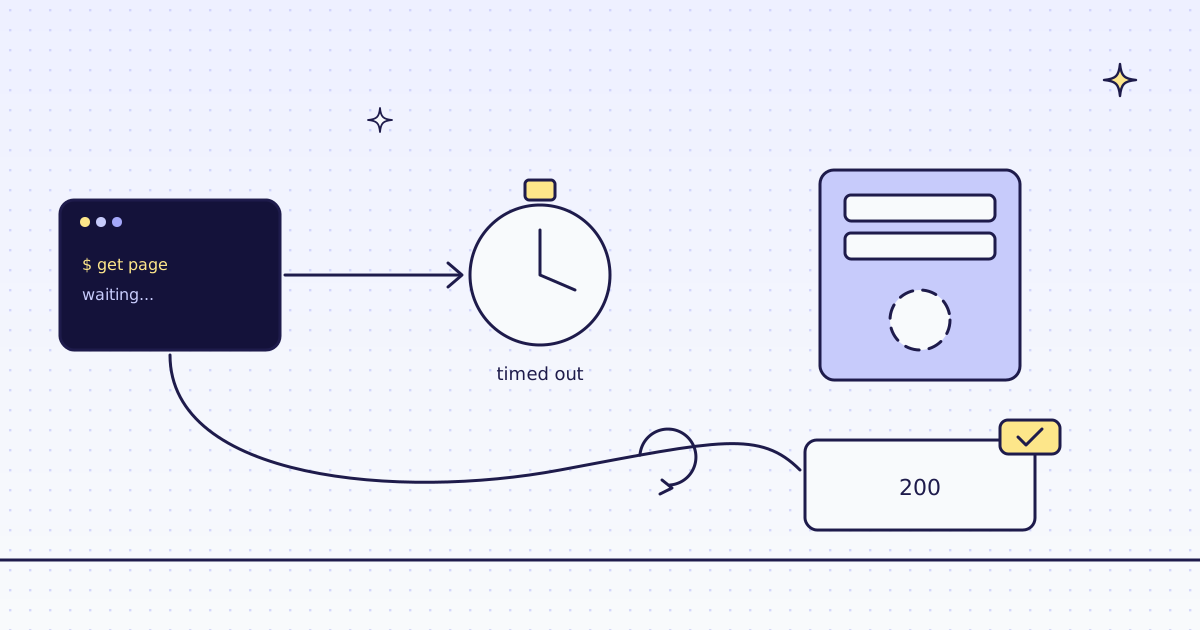
The short answer: The n8n HTTP Request node waits 300,000 ms, 5 minutes, unless you set Timeout under Options. When a limit runs out, the node fails with The connection was aborted, perhaps the server is offline, even when the server is up and only slow; the real cause is in the error's messages: timeout of 5000ms exceeded, code ECONNABORTED. Set Timeout to what your workflow can wait, and turn on Retry on Fail in the node's Settings with a few tries and a pause. When the page is slow because it needs a browser, point the same node at our API: an answer that runs out of time costs nothing.
What the n8n HTTP Request node does on a slow server
Start a listener in one terminal with nc -lk 8799. It takes each connection and never answers, like a server that hangs. Run this in a second terminal:
{
  "url": "http://127.0.0.1:8799/",
  "options": {
    "timeout": 5000
  }
}NodeApiError | The connection was aborted, perhaps the server is offline messages: timeout of 5000ms exceeded | httpCode: ECONNABORTED | node ran 5135 ms The same node with no Timeout option: timeout of 300000ms exceeded
- With no Timeout option, the node waited the full 300,000 ms, 5 minutes, before it failed, and the execution stayed open all that time.
perhaps the server is offlineis a guess. The server took the connection; it just never answered. ReadmessagesandhttpCodein the error.
How the n8n HTTP Request node reports a timeout
Our test store answers fast, so give it a limit too short to meet. The error is the same one a slow site gives you:
{
  "url": "https://lab.megalania.io/faq/",
  "options": {
    "timeout": 10
  }
}NodeApiError | The connection was aborted, perhaps the server is offline messages: timeout of 10ms exceeded | httpCode: ECONNABORTED | node ran 202 ms
- Our test store was up and answers in about 60 ms, and the node still said
perhaps the server is offline. The cause is inmessages: the 10 ms limit. - The node ran 202 ms for a 10 ms limit: the rest is n8n's own work around the request.
The free fix: timeouts and retries
Set a limit on every request, and retry a few times with a pause. This fixes servers that are slow now and then:
{
  "retryOnFail": true,
  "maxTries": 3,
  "waitBetweenTries": 2000,
  "parameters": {
    "url": "https://lab.megalania.io/faq/",
    "options": {
      "timeout": 20000,
      "response": {
        "response": {
          "fullResponse": true
        }
      }
    }
  }
}statusCode: 200 | node ran 500 ms | 1 item
- Timeout is under the node's Options. Retry on Fail, Max. Tries and Wait Between Tries (ms) are in the node's Settings tab, so they sit outside
parametersin the export. - Retry on Fail retries every error, a 404 too. Turn on Full Response to read
statusCodein the next node.
The fix that climbs: our API
Send the page to our API instead. We fetch it, run a real Chrome when you ask, and an answer that runs out of time costs nothing:
{
  "method": "POST",
  "url": "https://get.megalania.io/v1",
  "authentication": "genericCredentialType",
  "genericAuthType": "httpBearerAuth",
  "sendBody": true,
  "specifyBody": "json",
  "jsonBody": "{\"url\": \"https://lab.megalania.io/shipping/\", \"response_types\": \"markdown\"}",
  "options": {
    "timeout": 100000,
    "response": {
      "response": {
        "fullResponse": true
      }
    }
  }
}statusCode: 200 | x-route: http/datacenter | x-credits-charged: 1 | node ran 1965 ms # Shipping We pack every order by hand in recycled cardboard and paper tape. No plastic fillers.
- The key lives in an n8n Bearer Auth credential, not in the node. The page came back as Markdown in the item's
datafield; a JSON answer lands inbody. - Timeout 100,000 ms is longer than our own limit of 90 seconds a page, so the node gets our answer, not its own timeout.
The same call on a page whose list never finishes loading, with a 20-second limit:
{
  "method": "POST",
  "url": "https://get.megalania.io/v1",
  "authentication": "genericCredentialType",
  "genericAuthType": "httpBearerAuth",
  "sendBody": true,
  "specifyBody": "json",
  "jsonBody": "{\"url\": \"https://lab.megalania.io/new-arrivals/\", \"engine\": \"browser\", \"actions\": \"wait_for:#item-99\", \"timeout\": 20}",
  "options": {
    "timeout": 100000,
    "response": {
      "response": {
        "fullResponse": true,
        "neverError": true
      }
    }
  }
}statusCode: 422 | node ran 14601 ms error.code: action_failed error.message: actions entry 0 could not run: no visible element matched its selector in time, or the time for actions ran out. You are not charged.
#item-99never appears, so our Chrome waited until the time for actions ran out, and we answered422in under 15 seconds.- Never Error under Options lets a
422through as an item, so an IF node can branch onstatusCodeinstead of the workflow stopping.
One honest note: our test store is fast, so these runs show a short limit or a page that never gets ready, not a slow site. On a slow site, the call is the same; the price depends on the route that worked, and our MCP tool check_site tells you that price for free.
What it costs
| What we ran | Route | Credits |
|---|---|---|
| The shipping page as Markdown | h:dc | 1 |
| A page that never got ready, in the browser | c:dc | 0 |
The nc run, the short limit and the retry, straight from n8n | none | 0 |
Every rule is in Credits. Plans are on the pricing page.
How we measured: n8n 2.47.7 in Docker, HTTP Request node version 4.2, run with n8n execute on one Linux server, 17 Nov 2026. nc -lk 8799 (OpenBSD netcat) as a server that never answers. Our test store for the short limit and for the fix. Our API on our dev cluster for the last two nodes, against the same store on our dev domain. The code blocks are each node's parameters as n8n exports them; the outputs are fields copied from each execution's data.
Limits
- Public pages only. We do not log in, and we do not solve CAPTCHAs. When a page needs either, we stop and say so, for free.
- A page built by JavaScript needs
engine=browser. It costs more. See How to scrape JavaScript-rendered pages. - Slow can mean slow down. A site that answers slowly may be under load. Keep your rate low, fetch public pages only, and follow the site's terms and robots.txt.
What to do when a site answers 429 instead is in 429 Too Many Requests when scraping.