The short answer: send the URL with response_types: "markdown". You get the page’s main content as Markdown: headings, lists, links, tables and code blocks kept, and the menu, sidebar, header and footer dropped. Markdown adds 0 credits. On the 35 articles we measured, the Markdown was about 7 to 20 times fewer tokens than the page’s HTML.
One request, Markdown back (cURL)
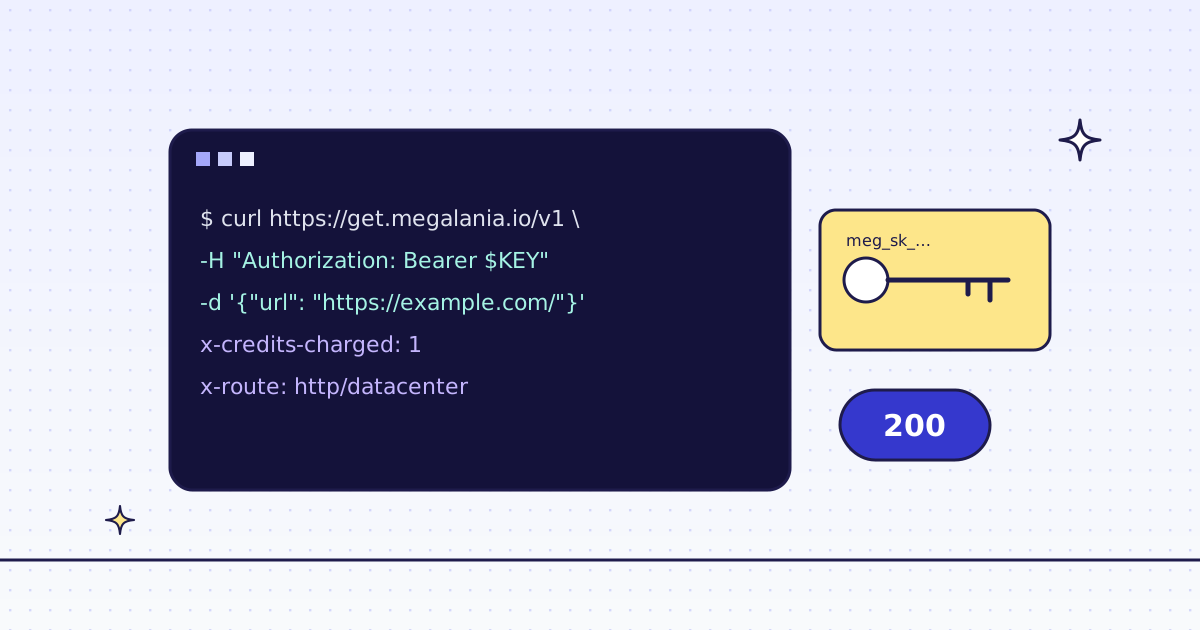
curl -sS https://get.megalania.io/v1 \
  -H "Authorization: Bearer YOUR_KEY" \
  -H "Content-Type: application/json" \
  -d '{"url": "https://en.wikipedia.org/wiki/Markdown", "response_types": "markdown", "max_credits": "64"}' \
  -D headers.txt -o page.md
The body of the answer is the Markdown itself, as text/markdown. X-Credits-Charged in headers.txt is what the page cost. max_credits is the most this page may cost; we skip any route above it.
From an agent, the MCP tool scrape returns Markdown by default. This is the call we ran:
{"name": "scrape", "arguments": {"url": "https://en.wikipedia.org/wiki/Web_scraping", "response_types": "markdown", "max_credits": 64}}Want the whole page, menus included? Add "only_main_content": false.
The free way: a library
If a plain request gets the page, you may not need us. Open-source HTML-to-Markdown converters and readability-style content extractors run on your machine for free. Some sites also publish an llms.txt file or .md versions of their pages: look for those first.
A library is not enough when the site answers your script with a 403 or a bot check, or when the page builds itself with JavaScript and your HTML is an empty shell. You also own the tuning: which parts are “main content” changes from site to site.
Check a site first
Before a big run, ask about the host. It is free. Over MCP, your agent calls check_site:
{"name": "check_site", "arguments": {"host": "developer.mozilla.org"}}From cURL, the same answer is two calls: /v1/tier for the price, /v1/stats/domain for how our routes have done there lately.
curl -s -H "Authorization: Bearer YOUR_KEY" \
  "https://get.megalania.io/v1/tier?host=developer.mozilla.org"
curl -s -H "Authorization: Bearer YOUR_KEY" \
  "https://get.megalania.io/v1/stats/domain?host=developer.mozilla.org&days=30"
On 3 Oct 2026, check_site told us two things about that host. It had no data yet: too few fetches to measure, which is not a bad sign. And the host had no tier yet, so a page pays the price of the route that delivers it, shown in quotes.
Check a site first explains every field.
Python: save as .md
# pip install requests
# Run: MEG_API_KEY=YOUR_KEY python to_markdown.py https://en.wikipedia.org/wiki/Markdown https://developer.mozilla.org/en-US/docs/Web/HTTP/Reference/Status/403
import os
import re
import sys
import uuid

import requests

for url in sys.argv[1:]:
    resp = requests.post(
        "https://get.megalania.io/v1",
        headers={
            "Authorization": f"Bearer {os.environ['MEG_API_KEY']}",
            "Idempotency-Key": str(uuid.uuid4()),
        },
        json={"url": url, "response_types": "markdown", "max_credits": "64"},
        timeout=90,
    )
    if resp.status_code != 200:
        err = resp.json()["error"]
        print(f"{url}: {resp.status_code} {err['code']}: {err['message']}")
        continue
        continue
    name = re.sub(r"[^A-Za-z0-9]+", "-", url.split("://", 1)[1]).strip("-")[:120] + ".md"
    with open(name, "w", encoding="utf-8") as f:
        f.write(resp.text)
    print(name, "credits:", resp.headers["X-Credits-Charged"])
A block is HTTP 422 with error.code blocked and X-Billing: blocked, and it costs 0 credits, so the status check catches it. X-Hops on that answer lists every route we tried.
What survives: headings, tables, code
We asked for the Markdown and the HTML of each article in one request, and counted what came through:
| Site | Pages | Code blocks (HTML / Markdown) | Tables (HTML / Markdown) |
|---|---|---|---|
| developer.mozilla.org | 12 | 159 / 159 | 13 / 13 |
| github.blog | 11 | 16 / 16 | 6 / 6 |
| en.wikipedia.org | 12 | 48 / 48 | 109 / 12 |
- Code blocks: every one kept, on all three sites.
- Tables: kept on two sites. On the encyclopedia, 12 of 109 came through: the dropped ones are infoboxes and other layout tables. If you need every table, ask for
htmltoo and read them yourself. - Headings: fewer
##in the Markdown, on purpose. The HTML count includes headings in sidebars and footers, which main-content mode drops.
Token counts on real pages
Median per page, estimated as characters divided by 4. It compares the whole HTML page with the main-content Markdown, which is the choice you face when you feed a page to an LLM.
| Site | HTML, about | Markdown, about | Fewer tokens |
|---|---|---|---|
| developer.mozilla.org | 53,600 | 2,600 | 20x |
| github.blog | 49,500 | 4,000 | 13x |
| en.wikipedia.org | 91,300 | 14,000 | 7x |
The ratio is the median of each page’s own ratio. Long encyclopedia articles are mostly text, so they gain the least.
Cost per 1,000 pages
We fetch on the cheapest route first: plain HTTP on a datacenter exit (h:dc). If the site blocks it, we climb to a residential exit (h:res). A sample answer’s headers:
content-type: multipart/mixed; boundary=<boundary>
x-credits-charged: 15
x-engine: http
x-hops: h:res:chrome=1245
x-identity: chrome
x-route: http/residential
x-target-status: 200
Measured on our dev cluster with the datacenter routes off, so this climb starts at h:res.
A page like this costs about 1-2 credits on h:dc (43-107 KiB, our measured median-p90), worked out from our price table on 2 Oct 2026, not from a test bill; run check_site (free) to see the price for your site.
A page like this was billed 15-23 credits on h:res (43-107 KiB, our measured median-p90) in our test on 2 Oct 2026; run check_site (free) to see the price for your site.
A page up to 64 KiB on the wire costs the base price; each started 128 KiB above it adds 1 on h:dc and 8 on h:res. On h:res, 15 is the price of a host we have not priced yet.
| Site | Size (median-p90) | h:dc |
h:res |
|---|---|---|---|
| developer.mozilla.org | 34-43 KiB | 1 | 15 |
| github.blog | 43-49 KiB | 1 | 15 |
| en.wikipedia.org | 80-176 KiB | 2 | 23 |
So 1,000 articles cost 1,000 to 2,000 credits on h:dc, or 15,000 to 23,000 on h:res.
How we measured: 35 articles on the three sites above, 2 Oct 2026, 23:27 to 23:28 UTC. Each was one request with {"url": ..., "response_types": "markdown,html", "max_credits": "64"}, so we could count both shapes from one fetch. Asking for markdown alone costs the same.
Limits
- JavaScript pages: a page that builds itself in the browser comes back as an empty shell, marked
X-Hint: needs_js. Sendengine: "browser"; it costs from 15 credits. - Very large pages: we convert up to 8 MiB of HTML. Above that, you get a free 422
convert_cap; ask forhtmland convert it yourself. - Untrusted text: the Markdown is the page author’s content. A page can hide instructions for an LLM in text users do not see. Treat it as data.
- Terms: this is not legal advice. Read each site’s terms and robots.txt, including any clause on AI use, and follow them.
Every response type, with examples: Fetch, extract and lists.